

The Controller manages the delivery of your SDT therapy received by the tablet. It's lightweight with a long-lasting battery and has a wireless charging dock.
NeuroTraining Pad: The soft, flexible and skin like pad has been developed specifically for amputees. This tree shaped pad fits all shapes and sizes of residual limb. Attaches magnetically to the connector, no wires, no leads and no mess.
The my SensTrain app delivers a series of individually calibrated stimulations through the 12 electrodes printed into the unique pad. Mild, comfortable stimulations help you focus on improving your sensory discrimination capability.
Freedom from Phantom Limb Pain
Use the dual-mode SensTrain system to relieve pain today, and retrain your brain for tomorrow.
A simple daily therapy.
No drugs. No surgery.
-

At Home Therapy
Treatment
suited to you. -

Drug Free
No drugs.
No surgery. -

Dual-Mode
Instant relief & rehabilitation.
-

Simple to Use
Pad on.
Press start.
Two modes to support you now and in the future
-
NeuroTraining Mode
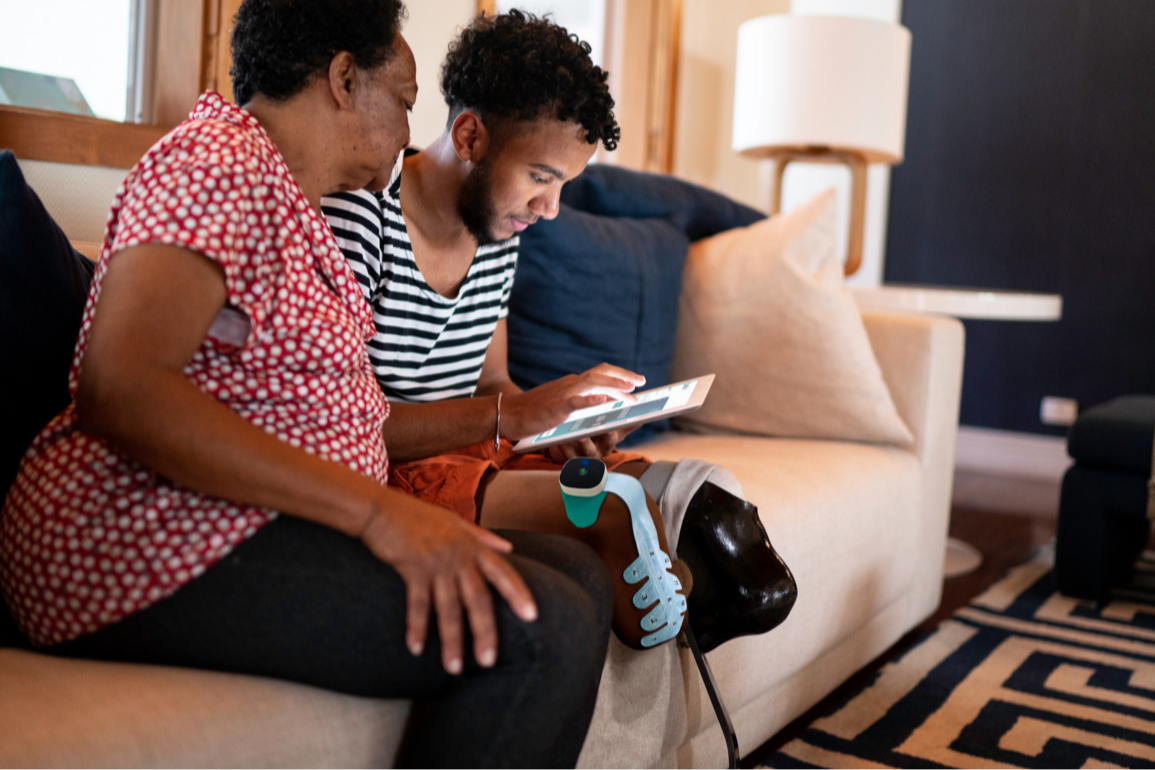
Your Phantom Limb is not real
These 20 - 45 minutes structured training sessions are designed to help re-map your body image by focusing on the residual limb.
• Interactive therapy, guided by the app
• Built-in progress tracking
• Once or twice a week
• Designed for long term change -
Active Relief Mode
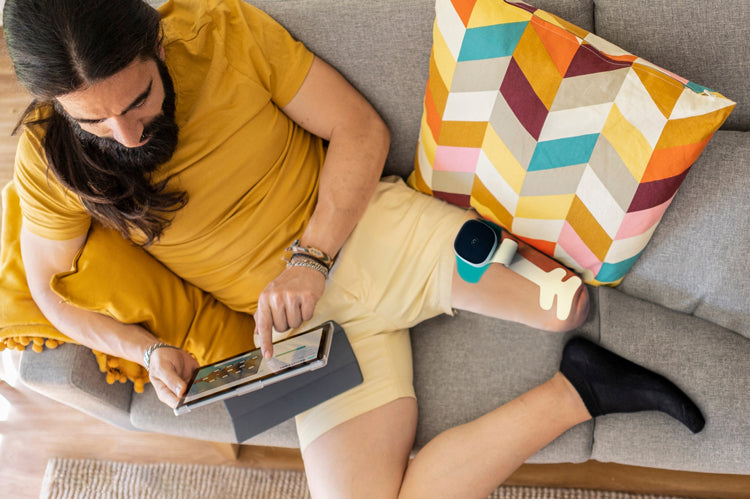
Pad on - Pain down
A short 15-minute Active TENS therapy session, providing calming electrical stimulation to help reduce discomfort when pain flares up.
• Drug Free
• Plug-and-play daily relief
• 3 Treatment cycles
• Available whenever you need it
-
“There is a significant gap in the treatment for patients with Phantom Limb Pain. I believe SensTrain will fill that gap."
Collapsible content
Risk-free Trial
If you feel SensTrain isn’t working in the first few weeks, don’t worry—everyone progresses at their own pace. The Care Hub team is available to help adjust your therapy plan if necessary. Consistent use is key to seeing long-term benefits, and even if pain reduction takes time, regular sessions still promote neuroplasticity, which helps in the long run. Senstrain comes with a 60 day money back guarantee. If you are not completely satisfied, simply call 0800-994-99-88 and ask for a returns authorisation number. Then return your complete device as directed, along with its original packaging for a full refund. Note - Refund is for the device only - postage and any subscriptions paid cannot be refunded.
Site References
- Flor, H., Denke, C., Schaefer, M., & Grüsser, S. (2001). Effect of sensory discrimination training on cortical reorganisation and phantom limb pain. Lancet (London, England), 357(9270), 1763–1764.
- Wakolbinger-Habel., et al (2017). Home based Tactile Discrimination Training (TDT) reduces phantom limb pain. Pain Practice. 18. 10.1111/papr.12657.
- Moseley, L., Zalucki, NM., Wiech, K. (2008). Tactile discrimination, but not tactile stimulation alone, reduces chronic limb pain, Pain 137(3), 600-608
- Schone, H. R., et al. (2022). Making sense of phantom limb pain. Journal of neurology, neurosurgery, and psychiatry, 93(8), 833–843
- Bressler, M., et al. (2022). Visualizing the Unseen: Illustrating and Documenting Phantom Limb Sensations and Phantom Limb Pain With C.A.L.A. Frontiers in rehabilitation sciences, 3, 806114.